NepState
 Continue with Google
or use email
By continuing, you agree to NepState's Terms and Privacy Policy
Continue with Google

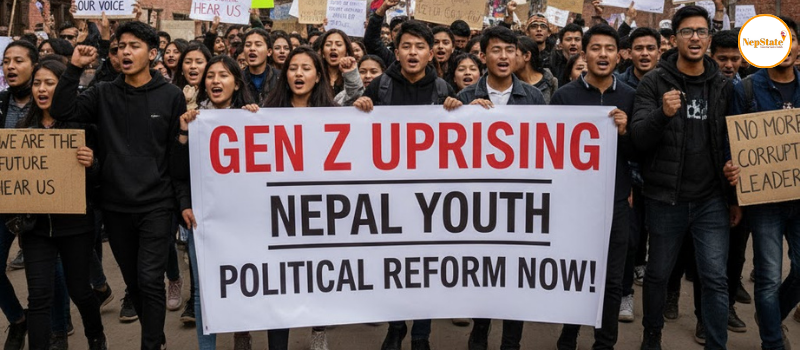
In September 2025, Nepal witnessed an unprecedented wave of youth-led protests, known as the "Gen Z Uprising," that brought the nation to a political crossroads. Triggered by a government ban on 26 social media platforms and fueled by widespread frustration over corruption and nepotism, these protests led to significant political upheaval.
On September 4, 2025, the Nepalese government suspended 26 popular social media platforms, citing regulatory non-compliance. However, many viewed this move as an attempt to suppress political dissent. The youth, who had been increasingly vocal about issues like government corruption and the lavish lifestyles of political elites, mobilized swiftly. Organizing through platforms like Discord, they took to the streets in mass demonstrations.
The protests escalated on September 8, 2025, when police opened fire on demonstrators, resulting in at least 72 deaths and over 2,100 injuries. The violence culminated in the storming and burning of the Nepalese Parliament building on September 9, leading to the resignation of Prime Minister K.P. Sharma Oli and the dissolution of the federal parliament.
In the aftermath, on September 12, 2025, Sushila Karki, former Chief Justice of Nepal, was appointed as the interim Prime Minister. At 73, she became the country's first female leader and was entrusted with leading a transitional government until elections scheduled for March 2026.
While Karki's appointment was seen as a step toward reform, many Gen Z activists expressed concerns over the lack of youth representation in the new cabinet and the slow pace of promised changes. Analysts warn that unless the political elite addresses the root causes of the uprising—such as corruption, unemployment, and lack of accountability—Nepal may face further unrest.
Nepal's Gen Z protests are part of a broader global wave of youth-led movements demanding political reform. Similar uprisings have occurred in countries like Madagascar, Indonesia, and Peru, often sparked by issues like government corruption and economic inequality.
As Nepal navigates this critical juncture, the role of youth in shaping the nation's future has never been more evident. Follow Nepstate for in-depth analyses, interviews with activists, and updates on the ongoing political developments.




Leave a Comment