NepState
 Continue with Google
or use email
By continuing, you agree to NepState's Terms and Privacy Policy
Continue with Google

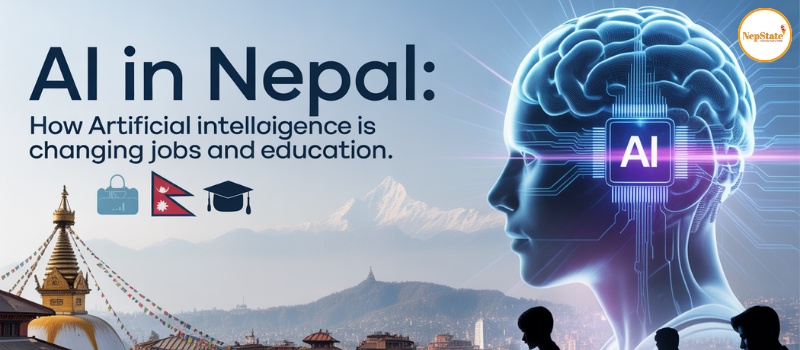
Artificial Intelligence (AI) is no longer a distant concept—it’s already transforming how Nepalis work, learn, and think. From classrooms to offices, AI has started reshaping the future of Nepal’s economy, workforce, and education system.
Let’s explore how this silent revolution is unfolding across the country.
AI is automating routine tasks and creating new kinds of employment opportunities at the same time. In Nepal, this transformation is visible across multiple sectors:
IT & Software: AI developers, data analysts, and machine learning engineers are in high demand.
Finance: Banks and fintech companies use AI for fraud detection, credit scoring, and chatbots.
Healthcare: AI tools are being tested for diagnosis support and patient data analysis.
Media & Marketing: Content creation, design, and SEO are now assisted by AI-powered tools.
While some traditional jobs may fade, new AI-related roles are emerging faster than ever. The real challenge for Nepali professionals is to upskill and stay adaptable in this evolving digital landscape.
Education in Nepal is also experiencing a quiet AI revolution:
Personalized Learning: AI-based platforms can now analyze student performance and suggest tailored lessons.
Virtual Tutors & Chatbots: Many EdTech startups are integrating AI tutors that guide students in real time.
Smart Assessments: Schools are adopting automated grading and feedback systems to save time and improve accuracy.
Language Translation Tools: Students from remote areas are benefiting from AI-powered translation and speech recognition, breaking learning barriers.
AI is helping schools and colleges move beyond rote memorization towards creative, data-driven education that prepares students for tomorrow’s tech-driven world.
Companies like Fusemachines, Paaila Technology, and Rumsan are pioneering AI innovation in Nepal.
Fusemachines has trained thousands of Nepali students in AI and data science.
Paaila Technology built Nepal’s first humanoid robot — Ginger — now used in banks and hotels.
Rumsan applies AI and blockchain to create digital identity and transparency solutions.
These startups are proving that Nepal has the talent to compete globally in the AI race.
AI presents massive potential — but also serious challenges:
Opportunities:
✅ Job creation in AI development and data science
✅ Improved efficiency across industries
✅ Access to quality education through EdTech
Challenges:
⚠️ Lack of AI-focused curriculum in schools
⚠️ Shortage of skilled AI professionals
⚠️ Limited government support for innovation and research
To unlock its full potential, Nepal needs stronger AI education programs, tech investment, and government support.
AI is not just about machines — it’s about people adapting, learning, and growing with technology.
If Nepal continues investing in digital literacy and innovation, it can become a regional hub for AI talent and solutions.
The time to prepare is now — because the future of work and education in Nepal is already being written in code and algorithms.
This article is for informational and educational purposes only. It does not represent any organization’s official position. Readers should conduct their own research or seek expert guidance before making decisions related to AI education, jobs, or investment.




Leave a Comment